Why a Safety Car Can Reshape a Race Without Changing the Order
See how a safety car compresses gaps, changes pit-stop choices and resets the tactical pressure even when every driver keeps the same place.
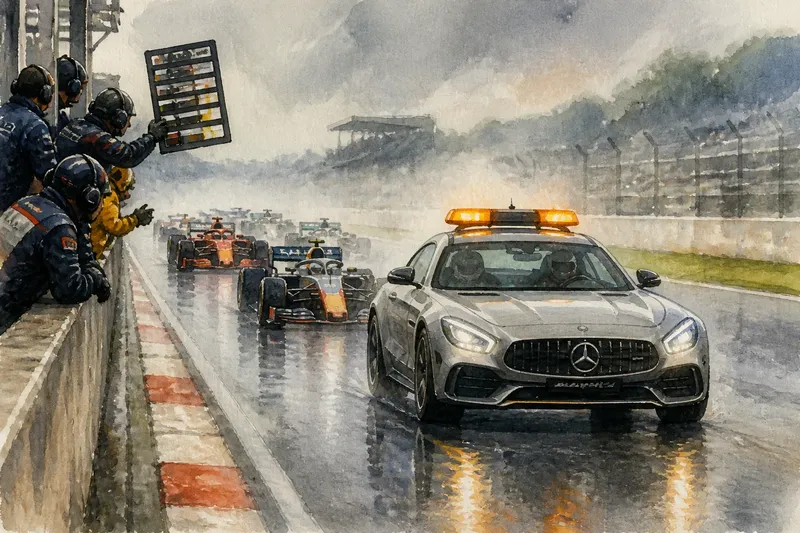
A safety car can leave the running order untouched and still make the race feel newly unsettled. The cars circulate in the same sequence, but the gaps between them shrink, pit windows shift, and a driver’s next decision may no longer resemble the one planned a lap earlier.
That is the essential effect of a safety car on race strategy: it changes the relationships between cars without necessarily changing their positions. Read the period as a moving pause, not a reset button.
Why do the gaps collapse?
When the safety car controls the pace, drivers must follow its speed and the event’s procedures rather than continue at racing speed. Cars behind catch up to the queue, so a large interval between competitors can contract sharply. The leader remains the leader; the advantage that made the lead comfortable may disappear.
This compression matters because a gap is more than empty track. It can give a driver room to pit without rejoining behind a rival, protect them from an immediate attack, or let them run at a pace that suits the tyres. Once the queue bunches, those cushions may be gone.
Track conditions and local rules shape the details. A safety car may be deployed for debris, a stranded car or difficult recovery work, and the procedure for pit-lane access can affect what teams can do while it is out. For a particular event, the sporting regulations and race-control instructions determine the precise options.
What changes in a pit-stop calculation?
A stop under green conditions costs time while rivals continue at speed. Under a safety car, the field moves more slowly, so the relative time lost can be smaller. That can make a planned stop attractive—or turn a routine choice into a sudden contest over who reacts first.
But the advantage is not automatic. A driver who pits may rejoin in traffic, lose track position to cars that stay out, or find that the tyre choice no longer suits the remaining stint. A rival who stays out might inherit the lead for now, yet face a later stop under less favourable conditions.
Teams weigh the tyre state, remaining distance, likely traffic and the positions of nearby cars. They also consider whether the incident is likely to clear quickly. A brief neutralisation may offer little time to act; a longer one could make a stop more appealing, but no one can treat the duration as certain.
How does the restart change the pressure?
As the field prepares to race again, the leader controls the pace within the rules, while those behind look for a clean launch and a usable route past. The gaps that once offered time to settle a car or plan an attack have vanished. A driver may have a rival close ahead and another close behind at once.
Tyre and brake temperatures can also be affected by the slower running, though the consequences depend on the car, conditions and compound. A driver may need to bring the tyres back into a useful operating range while avoiding wheelspin or a lock-up as speed rises. That makes the first moments after the restart a test of timing and control, not simply acceleration.
For a car that was managing a gap, the restart can be awkward: the buffer is gone, and the nearest rival may be ready to attack. For the pursuer, the same compression creates a chance to race closely, but also removes room to recover from a poor launch.
Which questions matter during a safety-car period?
Does a safety car erase a lead?
It can reduce a time advantage by compressing the field, but it does not automatically change the order. The leader still has track position unless a pit stop, penalty, incident or other race event changes it.
Should every driver pit?
No. The value of a stop depends on tyre condition, remaining race distance, traffic and the likely position after rejoining. Staying out can protect track position, while pitting can provide fresher tyres at the cost of places.
Can a driver attack immediately at the restart?
The driver must follow the event’s restart procedure and any race-control directions. Once racing resumes, a close gap may create an opportunity, but tyre grip, traffic and the available track space still govern whether an attack is sensible.
Why might a team delay its decision?
A team may be waiting for clearer information about pit-lane access, the incident, or what rival cars are doing. Delay has a cost if others stop first, but committing before the situation is understood can leave a driver with an unsuitable plan.
What can the unchanged order hide?
The timing screen records position, not comfort. Two cars shown in the same places may now be separated by a fraction of the earlier gap, with different tyre ages and different prospects for the remaining race. The leader’s apparent control may have weakened, while a car behind may have gained a realistic chance to attack.
Imagine a driver leading with a clear stretch of track behind and tyres that are beginning to fade. A safety car bunches the field; the team keeps that driver out while a nearby rival pits. The leader retains the place, but the rival returns on fresher tyres and close enough to apply pressure after the restart. The observable change is not a new position during the neutralisation—it is a new contest once racing resumes.
What should a viewer watch besides position?
- Gap to the next car: Notice how quickly the interval contracts as the queue forms.
- Pit-lane activity: See which nearby rivals stop, and whether their choices alter the leader’s options.
- Tyre age and type: Compare the likely grip available to cars that pit and those that stay out.
- Rejoining traffic: Watch whether a driver who stops returns in clear air or behind a pack.
- Restart spacing: Observe how tightly the cars line up and which drivers appear positioned to attack or defend.
For anyone trying to understand how a safety car reshapes a race, the useful question is not only “Who moved up?” Ask instead: who lost the gap that made their strategy comfortable, and who gained a chance to challenge? The order can look unchanged while the tactical balance has already shifted.