The Apex Is a Reference Point, Not a Single Racing Line
The apex of a corner helps locate its geometry, but entry, exit and the next bend determine which racing line makes sense.
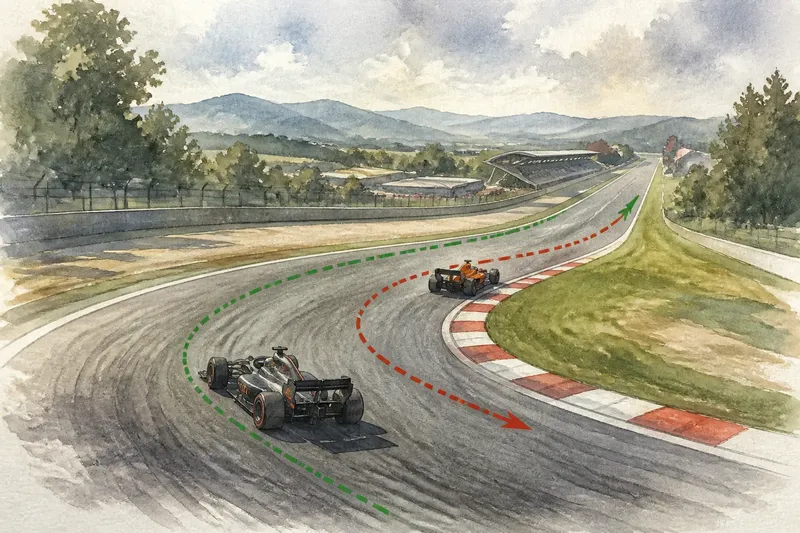
On a circuit map, the apex looks like a dot; on track, the best racing line may touch it, miss it or approach it from an unexpected angle. The apex of a corner is a useful reference for describing where a car is nearest the inside edge, not a command to steer toward one magic point. To understand a line, follow the whole corner—and the strip of track beyond it.
What does the apex actually describe?
In ordinary circuit language, the apex is the inside part of a turn that a car passes closest to. It gives drivers, engineers and commentators a shared landmark. A left-hand bend has an inside edge on the left; its apex is the point along that edge associated with the car’s closest approach.
That description is deliberately simpler than the path a car drives. A corner has an entrance, a changing arc and an exit, while the car traces a continuous curve through all of them. The apex helps identify a place within that geometry, but it does not specify where the car should begin turning, how tightly it should rotate or where it should finish.
Even the phrase “hit the apex” can hide different ideas. A driver might brush the inside curb, leave a small gap or reach the closest point without touching anything. The useful question is not whether the tire meets a painted mark, but whether the car’s path serves the corner and the section that follows.
Why doesn’t every corner have one ideal line?
A racing line is a route through a corner, shaped by the car’s direction and the limits of the usable surface. A broad, steady-radius bend may reward a smooth arc. A tight turn followed by a long straight may call for a later approach to the inside, so the car can begin accelerating sooner while pointing toward the exit.
The circuit’s boundaries matter too. A curb can open the usable surface, unsettle a car, or be awkward to reach; a painted strip may offer a different grip from the asphalt beside it. The driver has to fit the path to the track’s shape and surface, not to an abstract diagram of a perfect curve.
There is also a difference between a line that makes sense for one corner in isolation and one that makes sense across a sequence. The first might carry the car toward the next turn at an awkward angle. The second may sacrifice a little in the current bend to arrive better positioned for what comes next.
How do entry and exit change the apex?
Entry describes the car’s approach and the point where it starts turning. Exit describes the path out of the bend as the steering unwinds and the car heads toward the next piece of track. These phases frame the apex: shift either one, and the car’s closest pass to the inside can shift as well.
A late apex generally means the car reaches its closest point to the inside later in the turn than it would on an earlier arc. That can leave the car straighter and better pointed toward an exit, particularly when the following straight matters. It is not automatically superior; the entry may need more patience, and the turn’s shape might not reward that approach.
An earlier apex can suit a corner where the car must change direction again soon after leaving it. But if the driver turns in too soon for a bend that tightens, the car can run out of room at the exit. The visible inside point is only one part of the bargain: the car also needs enough track to finish the corner.
Imagine a driver approaching a right-hand hairpin that leads onto a long straight. Starting the turn later and reaching the inside farther into the bend could help the car point toward the straight sooner; the observable result would be a cleaner exit trajectory, though the approach itself may feel more deliberate. If a second bend immediately follows instead, that same path could leave the car poorly placed for the next change of direction.
What should you look at when comparing racing lines?
Watch the car’s path from before turn-in to the moment it settles onto the exit. A still image at the apex can show where the car is, but not whether it arrived too early, had to wait before accelerating or used the available exit width well.
- Turn-in: Note where the car begins to change direction relative to the track edge or a visible marker.
- Inside approach: Look for the closest pass to the inside, including whether the car uses a curb or leaves space.
- Car attitude: Watch whether the nose points toward the exit or remains aimed at the inside as the car passes it.
- Exit path: See how much track the car uses while unwinding its steering and accelerating away.
- Next corner: Check whether the exit position leaves the car ready for the next turn or forces a correction.
These clues make two lines easier to compare without pretending that one marker explains everything. The same car can use a different route in traffic, and a driver may choose a path that leaves room alongside another car rather than occupying the ideal solo trajectory.
How do track sequences and traffic reshape the line?
In a linked sequence, the exit of one corner often becomes the entry to the next. A driver may stay away from the first apex to position the car for a sharper second turn, or leave extra room to avoid arriving at the next bend on the wrong side of the circuit. The line is a connected decision, not a set of independent sketches.
Traffic makes that decision visible. A car defending the inside may force a following driver onto a wider entry; a car attempting an overtake may choose a path that prioritizes overlap and a safe exit over the neatest arc. The apex remains a useful landmark, but it cannot tell you whether the driver has room to use the usual line.
Track conditions can alter the choice as well. A damp patch, debris or a slick painted surface may make the familiar path less appealing, while a curb can be more disruptive to one car than another. Drivers adapt to what the surface and nearby cars allow, so the line seen in one lap need not be the line used in another.
Which questions help make sense of an apex?
Is the apex the middle of a corner?
Not necessarily. It marks the car’s closest approach to the inside, which may occur before or after the geometric middle of the bend. The corner’s shape and the intended exit influence where that point lies.
Does a car need to touch the curb?
No. A curb is part of the track environment, not a required target, and its surface or shape may not suit a particular line. Watch the car’s path and balance rather than treating contact as proof of a good corner.
Why might two drivers use different lines?
They may be responding to different positions on track, traffic, surface conditions or the next corner. Their cars may also behave differently, so a route that helps one driver rotate and exit cleanly may not suit another in the same way.
Can the fastest line change from one lap to another?
Yes. A driver may be defending, overtaking, avoiding a compromised patch or setting up for the next turn. The circuit geometry stays put, but the useful path through it depends on the situation.
How should you read an apex on a circuit map?
Use a map’s apex mark as a label, not a prescription. It can help you identify the inside of a bend and compare that location with the entry and exit, but a simplified drawing cannot show every surface detail, traffic situation or linked-corner choice.
When following a race, try tracing each car from approach to exit, then look ahead to the next turn. The apex of a corner becomes much more informative when you treat it as one reference point in a complete path: it tells you where the car came closest to the inside, while the entry, exit and following section explain why that route made sense.