From Grand Prix Distance to a Timed Race: Two Ways to Set an Endpoint
Grand Prix distance vs. timed race formats shape when the finish arrives, how teams manage pace, and why the final lap can be predictable—or uncertain.
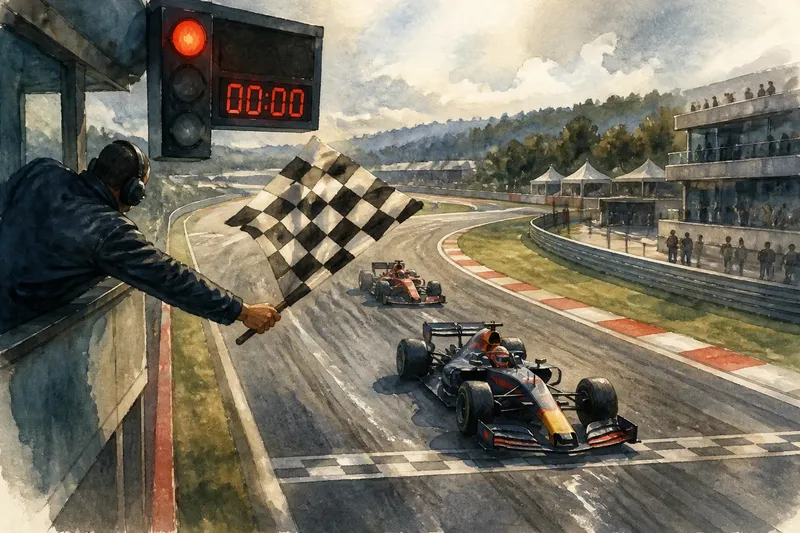
Grand Prix distance vs. timed race: the difference becomes vivid when a leader reaches the final lap with a comfortable cushion, only for the clock to keep running. One format sets the finish by a fixed amount of circuit to cover; the other lets elapsed time decide when the contest is nearly over. That small design choice changes what drivers can know, what teams must manage, and how the last laps feel.
1. What does a distance-based race promise?
A distance-based race ends when the field completes a prescribed number of laps or covers a stated circuit distance. The finish is attached to the track: drivers must get around it the required number of times, and the chequered flag follows the leader’s completion of the final lap, subject to the event’s regulations.
That gives the contest a visible unit of progress. A driver can count the remaining laps, compare positions on the timing screen, and judge how much road remains before the finish. Even when a race is interrupted or affected by a slow period, the distance target remains the basic destination; regulations determine how interruptions are handled.
Distance formats also make the circuit itself part of the event’s scale. A lap at a tight, technical venue may demand a different rhythm from a lap at a fast circuit, but the required number of tours gives everyone the same stated distance to contest. The organizer can set that distance to suit the event’s intended duration and character, while the sporting regulations define how it is counted.
For the driver, a fixed lap count can make the closing phase easier to map. “Five to go” is an instruction with a concrete shape: five more visits to the same braking zones, corners, and passing opportunities. A driver may still have to respond to traffic, tire condition, or a rival’s pace, but the endpoint does not move simply because one lap takes longer than expected.
2. What does a timed race leave open?
A timed race sets an allotted running time rather than a fixed number of laps. When that time expires, the field typically completes the lap in progress before the finish is declared, according to the series’ rules. The exact procedure matters: a countdown reaching zero does not necessarily mean the flag appears at that instant.
Here, the circuit determines how much distance fits into the available time. A clear run at a quick venue may yield more completed laps than a disrupted run at a slower or more demanding one. The endpoint is still governed by a rule, but the number of laps required to reach it is not fixed in advance.
This format makes the clock a live part of the contest. Drivers and teams watch not only the gap to a rival but also how much time remains and whether the current lap is likely to be the last. A slow lap, traffic, or a caution period can alter that calculation without changing the length of the allotted session.
Timed races can also be convenient for a schedule that needs a bounded slot. Yet a stated duration is not a promise that the finish will occur at an exact minute: the final lap procedure, interruptions, and event rules shape the actual moment. The useful question is not merely “How long is the race?” but “What happens when the clock runs out?”
3. How does each format define the finish?
In a distance race, the field is pursuing a known quantity of circuit. The leader’s progress toward the required lap count sets the approaching finish, and competitors can see the remaining distance shrink in whole laps. If regulations alter the race after an interruption, the official classification and restart procedure supply the answer, not an improvised change in the endpoint.
In a timed race, the clock reaching its limit triggers the finish sequence, which often means the race ends after the leader completes the lap already underway. A driver who crosses the line just before time expires may therefore face another full lap, while a driver on a different part of the circuit may see the finish come sooner in terms of their remaining distance.
That distinction affects what “one lap to go” means. In a distance format, it is usually a direct statement about the prescribed total. In a timed format, teams may estimate that the current lap is the last, but the actual signal depends on timekeeping and the applicable finish rule. Race control’s messages and the series’ regulations are the dependable reference.
Imagine a fictional event in which a driver leads as the clock approaches its limit, while a rival is close enough to attack. If the leader is already on the final lap when time expires, the pair may have only the remaining corners to settle the result; if the leader has just crossed the line, they may have another full circuit. The observable consequence is a different amount of racing after the same clock reading, not a different rule of competition.
4. What changes for strategy and pace?
Distance gives teams a lap-based planning frame. They can divide the event into phases, coordinate a scheduled stop where the format permits one, and consider how long a tire choice must last in laps. The plan still has to adapt to conditions, but “remaining laps” provides a stable unit for discussing pace and wear.
Time makes the remaining workload less certain in laps. A team can estimate how many circuits may fit into the remaining minutes, but traffic, interruptions, and lap pace can shift that estimate. That uncertainty can affect how a driver approaches a late stint: a move that seems worth attempting with several laps left may look different if the clock suggests only one more chance.
Neither format dictates a single driving style. A distance race does not automatically reward conservation, and a timed race does not automatically favor aggression. The circuit, car, tires, regulations, and race situation still matter; the format changes the information teams use to judge when risk is worthwhile.
Say a fictional team is deciding whether its driver should defend a position or preserve tires. In a distance race, the engineer can frame the choice around a known number of laps to the flag; in a timed race, the engineer must also account for whether the clock is likely to leave another lap after the current one. The expected observable result is a different conversation over the radio, shaped by the endpoint rather than by a change to the car.
5. Why can a timed finish feel less predictable?
The uncertainty comes from the relationship between the clock and the circuit. Time expires while cars are spread around the track, so the same remaining duration can leave one driver nearing the line and another still working through a sequence of corners. The lap-in-progress rule turns that spread into different amounts of racing before the flag.
That can create a late phase with a distinct kind of suspense. A rival may need to attack now because another lap is uncertain, or hold position because a further circuit could still arrive. Meanwhile, teams must interpret the countdown alongside the order of cars on track, rather than treating a lap counter as the only guide.
A distance finish can have uncertainty of its own. A close battle may intensify over the final lap, and an interruption can complicate how much racing remains. But absent a regulation-driven change, the underlying lap target offers a firmer forecast of the remaining circuit than a clock whose expiration occurs at different points around the course.
For spectators, the two formats encourage different kinds of attention. A lap counter makes the approach to the finish easy to follow; a timed contest invites viewers to watch the clock, the leader’s position on the circuit, and any official signal together. Neither is inherently more dramatic. One gives the audience a countable distance, the other a deadline whose final shape depends on where the field is when it arrives.
6. Which format suits a particular event?
A distance-based format suits an event whose sporting identity is tied to completing a defined amount of racing. It can make the intended workload legible and give teams a fixed lap count for planning. The tradeoff is that elapsed duration can vary with circuit pace and interruptions, so a distance target does not by itself create a tightly bounded broadcast slot.
A timed format suits an event that needs a defined running window or wants the clock to be part of the late-race calculation. Its duration is more bounded in principle, but the finish still depends on the rule for completing the lap in progress and on any interruption procedures. Organizers and competitors need those details to be clear before the start.
Many series choose a format as part of a broader event design, not as a claim that one endpoint is universally superior. A long-distance contest may emphasize sustained management, while a short timed race may make the countdown prominent; those qualities come from the whole package of regulations and circuit conditions, not from the endpoint alone.
When comparing two events, check the published sporting regulations for the distance or time limit, the treatment of a lap in progress, and what happens after a stoppage. The label “timed” or “distance” gives the outline; the finish procedure supplies the detail.
What do readers often ask about race endpoints?
Does a timed race stop the moment the clock reaches zero?
Usually, the clock triggers the finish procedure rather than an instant stop for every car. Many formats allow the leader to complete the lap already underway, but the event regulations determine the exact rule.
Can a distance race be shortened?
It can be altered under the relevant regulations, for example after a serious interruption or when officials apply an authorized procedure. The original distance is the planned endpoint, but race control’s official instructions govern any change.
Why might two cars complete different numbers of laps in a timed race?
Cars may be at different points on the circuit when time expires, and their pace or time lost in traffic can vary. The finish procedure can therefore leave them with different completed-lap totals while still ranking them under the same rules.
Which format is easier for a viewer to follow?
A lap count makes remaining distance immediately visible, while a timed race asks viewers to combine the clock with the leader’s location and finish signals. Timing screens and clear race-control messages help make either format legible.
7. What should you watch in the closing phase?
For a distance race, watch the remaining-lap count alongside the gaps between cars. The number tells you how much circuit remains; the gap shows whether a rival has time to turn pressure into an actual passing opportunity.
For a timed race, track the clock and the leader’s position on the circuit together. If the leader is approaching the line as time expires, the next lap may be decisive; if the leader has just crossed it, the field may have a longer final stretch. Listen for official messages, since a projected finish is not the same as the confirmed one.
That is the practical distinction behind Grand Prix distance vs. timed race: one names the amount of circuit to complete, while the other names the running time that begins the final sequence. Once you know which endpoint governs the event—and how its rules handle the lap in progress—you can read the closing contest with much sharper eyes.