Ground Effect and Wings: Two Routes to Downforce
Ground effect and wings create downforce in different ways; learn how pressure, airflow and sensitivity shape their roles in a racing car.
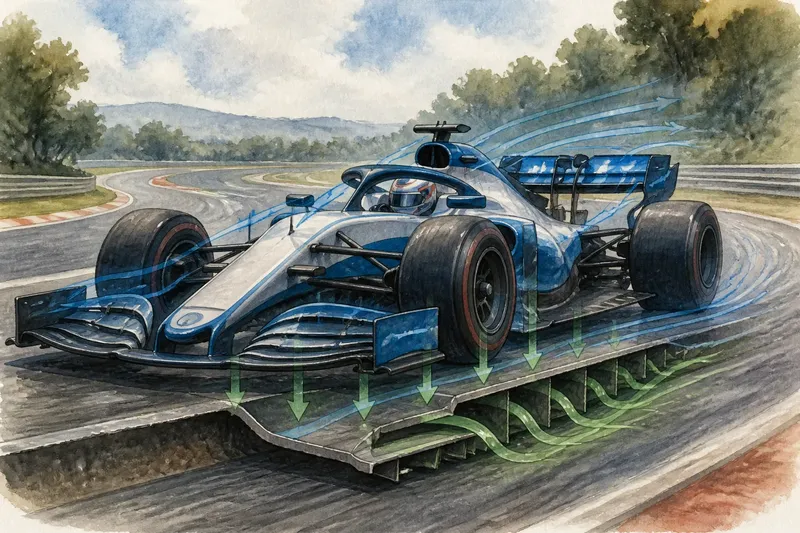
Ground effect and wings both press a racing car toward the track, but they do it by shaping airflow in different places. If you are trying to understand why a car can feel planted in one part of a corner and unsettled in another, the distinction matters: underbody downforce depends on the air beneath the car, while wings generate force through exposed surfaces above it.
Why does underbody downforce depend on the floor?
A racing car’s floor, tunnels and diffuser form a carefully shaped passage for air. As the car moves, air is guided beneath the chassis; changes in the passage’s shape influence its speed and pressure. The resulting pressure difference between the underside and the air around the car can push the car downward. This broad principle is often called ground effect.
The floor is not simply a flat board sucking the car toward the asphalt. Its contours, edges and exit geometry work together, and the gap between the car and track affects the airflow. The diffuser, which opens out toward the rear, helps manage the air leaving the underbody. If that flow stays organised, the floor can produce substantial downforce without relying on a large wing.
That contribution can also be sensitive. A change in ride height, pitch or roll alters the narrow space available to the air, so the underbody’s aerodynamic behaviour may shift as the car moves over bumps or loads up in a turn. If the flow becomes disrupted, downforce may drop or become less consistent.
What do wings do differently?
A wing is an inverted lifting surface: its shape and angle guide air so that pressure differs across its surfaces, producing a downward force on the car. Front and rear wings can direct airflow as well as create downforce, which is one reason their effects reach beyond the force they produce on their own.
Unlike the floor, a wing works in exposed air. Its performance depends on the flow arriving at the wing, the angle and shape of its elements, and interference from nearby parts of the car. A front wing, for example, meets relatively clean air first, while the rear wing operates farther back in airflow already affected by the body and other aerodynamic components.
Wings also create drag: the aerodynamic resistance that grows as a car pushes air aside. Their visible size makes them easy to notice, but appearance alone does not reveal their total contribution. A compact wing can still influence the car’s airflow, and a large one may not tell the whole story if the floor is doing much of the work.
Why can a car feel unsettled when its speed changes?
Aerodynamic forces generally become stronger as airflow over the car becomes faster, so the balance between tyre grip, suspension movement and downforce changes with speed. The car may feel more supported in a quick corner than in a slow one, even if the driver’s steering input looks similar. That sensation does not mean the wings alone are responsible; the floor, bodywork and wings form one interacting system.
If the front and rear do not gain aerodynamic load in step, the car’s balance can shift. A driver might describe the front as reluctant to turn, or the rear as less settled, but those sensations can have several causes. The useful engineering question is not simply “Which part makes more downforce?” It is “How does the whole car’s aerodynamic balance change through this condition?”
Imagine a fictional car that feels secure through a fast bend but becomes nervous when it meets a crest. The crest changes the car’s attitude and the floor’s clearance, while the wings continue to meet the surrounding airflow. Engineers examining that pattern would consider how the underbody and wings respond together, rather than treating the floor as a separate source of grip.
What causes downforce to become inconsistent?
Several common problems can make aerodynamic behaviour harder to predict. Each points toward a different part of the system:
- Ride-height sensitivity: The floor’s working gap to the road changes as the car compresses or rises. Consider whether the symptom appears with bumps, crests or heavy cornering.
- Flow separation: Air can stop following a surface cleanly, reducing the intended aerodynamic effect. Look for a pattern tied to a particular speed or car attitude rather than assuming a single component has failed.
- Wake disturbance: Air arriving at a wing may already be turbulent or deflected by other parts of the car, or by another car ahead. Consider whether the behaviour changes in traffic.
- Balance mismatch: Front and rear aerodynamic forces may not change together across speed or attitude. Compare where the handling change occurs, not just how strong it feels.
These are diagnostic possibilities, not a setup recipe. Actual design choices depend on the car and its permitted specification; manufacturer instructions and the applicable series rules govern any real technical work.
Which aerodynamic questions should you ask?
Does ground effect mean the car has no wings?
No. Ground effect describes downforce generated through the underbody, not a wing-free design. A car can use a floor and diffuser alongside front and rear wings, with each part influencing the airflow around the others.
Are wings less sensitive than the floor?
Not automatically. Wings avoid depending on the tiny clearance beneath the car, but their airflow can be disturbed by changes in attitude, nearby components or another car’s wake. Sensitivity depends on the design and operating conditions.
Why not make the wings do all the work?
Wings produce drag as well as downforce, and their airflow interacts with the rest of the car. A floor can provide another route to aerodynamic load, so engineers consider the balance of the complete package rather than asking one part to do everything.
Can more downforce always make a car faster?
No. Downforce can help tyres maintain grip in corners, but the drag associated with producing it can hinder acceleration and top speed. The useful balance depends on the circuit, the car and the demands of the race.
How should you compare the two routes?
Think of the floor as an aerodynamic system built around a constrained passage under the car, and wings as exposed surfaces that shape the flow around it. That distinction explains why ride height and car attitude loom large in discussions of ground effect, while incoming airflow and drag often enter conversations about wings.
Neither route works in isolation. The floor’s exit flow affects what happens downstream, and wings can guide or disrupt air reaching other surfaces. When a car’s behaviour changes, the most useful first question is where in its motion the change appears: with speed, with a shift in attitude, or in disturbed air behind another car.
That is the practical value of understanding ground effect and wings: it gives you a way to interpret aerodynamic claims without mistaking a visible component for the whole design. Watch how the car responds across different conditions, then consider which airflow path those conditions are most likely to disturb.