A Race Programme Before the Broadcast Era
A race programme before the broadcast era helped spectators read the meeting, find the venue and follow its schedule before live updates arrived.
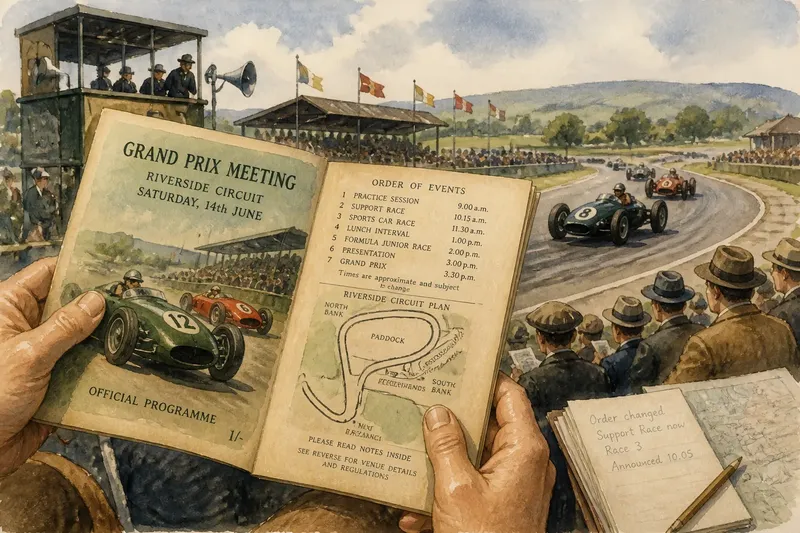
A race programme before the broadcast era was the spectator’s guide to a day whose details might otherwise be scattered across a gate sign, a loudspeaker announcement and the people sitting nearby. Its paper pages introduced drivers and cars, laid out the meeting’s schedule and gave the venue a shape a visitor could carry in a pocket.
That modest job made the programme part of the occasion, not simply a souvenir. A reader could study it on the journey in, consult it between races and take it home with a personal record of who had appeared and what the day promised. The routine below follows that paper guide from the week before a meeting to the journey home.
What could a programme tell you before race day?
In the days before the meeting, a programme could help a spectator decide whether the event suited the people going and how to plan the visit. The cover identified the meeting and its venue; inside, the printed schedule showed the expected order of races, while practical notes might describe access, facilities, or the rules for admission. The exact contents varied with the organizer and the event.
Names and short biographies gave the races a human cast. A driver’s entry could connect a name to a car, an entrant, or a home club, giving an unfamiliar field some legible landmarks. Such details were useful even when a spectator knew little about the machinery: a name already marked on the page was easier to recognize over a loudspeaker or in conversation.
For a visitor unfamiliar with the circuit, venue information mattered just as much as the grid. A printed map might distinguish the spectator areas, gates, paddock access and facilities, although not every programme offered the same level of detail. Before setting out, a reader could note the venue address and identify the entrance relevant to their ticket or travel plans.
Use the programme to make a short list of what to confirm before leaving: the meeting name, the venue, the published start time, the entrance and any instructions affecting spectators. If an item is missing or unclear, ask the organizer rather than treating a decorative map or old copy as current guidance.
How should you read the schedule on arrival?
At the circuit, start with the timetable rather than assuming the first race on the page begins the whole day. A meeting could include supporting races, practice or qualifying sessions, ceremonial moments and breaks; the schedule showed how these parts were arranged, not just the headline contest. Read the sequence once, then mark the events you most want to see.
Keep the timetable as an order of expectation, not a promise that every session will begin at precisely the printed moment. Track conditions, delays or other changes could disrupt the planned sequence, and a programme already printed could not update itself. A public-address announcement, an official notice or a steward’s direction would take precedence over the paper.
The programme’s venue plan also helped turn a large circuit into a sequence of places. A spectator could locate a viewing area, then check how far it was from a gate, grandstand or refreshment point before deciding where to spend the interval. Follow posted signs and staff directions if they differ from the printed map.
Say you arrive with a programme that lists a support race before the main event, but an announcement says the order has changed. Keep the printed entry as a reference for the participants, then follow the announcement for timing and move to the intended viewing area only if access remains open. That small distinction—paper for context, live notice for the current plan—prevents an old schedule from becoming a bad instruction.
What should you do when the printed plan changes?
When a session is delayed, look for a current announcement before interpreting the gap. A silent track does not by itself tell you whether the race is postponed, cancelled or simply waiting on another part of the meeting. If the change affects where spectators may stand or walk, use the circuit’s current signs and staff guidance.
If a driver or car is withdrawn, the programme may still show the original entry. Treat that listing as a snapshot of the intended field, not proof that every named participant took part. An announcement or an official result, where supplied, can clarify what happened; writing a brief note beside the relevant entry can help preserve the distinction later.
For a schedule change, annotate the page lightly rather than trying to erase the printed plan. A pencil note such as “order changed” or “session delayed” keeps the original information visible while recording what you heard. If the announcement is hard to catch, check with an official or another clearly posted notice instead of relying on a guess.
That practice also helps with practical decisions. If a delay leaves time to move, consult the map and current access instructions before crossing the venue; if the event is continuing, return to the nearest safe spectator area rather than following activity toward restricted parts of the circuit.
How did the programme differ from live information?
A printed programme was prepared in advance, so its strength was arrangement: it gathered the expected participants, schedule and venue details in one portable object. Its weakness followed from the same quality. Once printed, it could not reflect a late entry change, a revised running order or an event already under way.
Live information works differently. A broadcast or current digital feed can describe events as they unfold, show changing positions and communicate updates without waiting for a reader to interpret a page. It is better suited to immediacy, but it does not necessarily give a visitor the same compact map of the whole meeting, nor does it become a keepsake simply by being current.
The older programme therefore asked spectators to combine sources. Read the paper for the intended structure and names; listen for changes; use signs and staff for present-day movement and access. That division of labor is more accurate than imagining the booklet as a complete record of the race.
It also shaped the social experience. A printed entry encouraged spectators to compare names, point out a car to a companion or keep track of the meeting’s sequence together. Conversation and the public-address system filled gaps the page could not, while the page gave those fleeting announcements a durable frame.
What should you look for in a surviving programme?
A surviving copy can be read as a record of what organizers expected spectators to know. Check its cover and meeting title first, then look for the timetable, entry list, circuit map and practical notes. Notice whether the schedule distinguishes sessions or races, and whether the map marks spectator facilities separately from paddock or official areas.
Next, compare the advertised participants with any handwritten notes, annotations or marks left by a reader. A circled name might indicate a favorite, a pencilled change could record an announcement, and a folded page may show which part of the day drew attention. These traces do not establish what actually happened on track, but they reveal how someone used the programme as a working guide.
Look closely at the language of the listings, too. A name beside a car or entrant links the meeting’s human and mechanical sides, while the order of entries can show how the organizer presented the event to spectators. Avoid treating an absent detail as proof that it was unimportant; the programme could be selective, and space on the page was limited.
If you are carrying an old programme to a present-day circuit, treat it as historical context rather than current directions. Venue layouts, access arrangements and schedules can change, so consult the organizer’s current information for the visit itself.
Which programme details are readers most curious about?
Did every spectator receive a race programme?
Not necessarily. Availability and distribution depended on the event and its organizer, and a programme could be sold, handed out or supplied in another way. A surviving copy tells you what its reader could consult, not how every person at the circuit followed the meeting.
Did a printed schedule list every session?
It could list the planned sequence, but the level of detail varied. Some programmes gave space to supporting events and practical information; others emphasized the main races and their entries. In either case, later announcements could supersede the printed order.
Could the programme identify who was in each car?
Entries often connected a driver with a car or entrant, but the exact information depended on the publication. A late change might not appear in copies already printed, so use an official announcement or result to distinguish an intended entry from a confirmed appearance.
Why keep a programme after the meeting?
It preserved the event’s planned cast, schedule and setting in a form a spectator could revisit. Notes and folds might add traces of how that person followed the day, while the printed pages retained the organizer’s original account of what was expected.
A race programme before the broadcast era was most useful when treated as both a map of intentions and a record worth annotating—not as a live authority. Read its names and layout carefully, then let current announcements guide decisions that depend on what is happening now. That habit preserves what makes the paper distinctive while keeping the day’s practical choices grounded in the latest information.